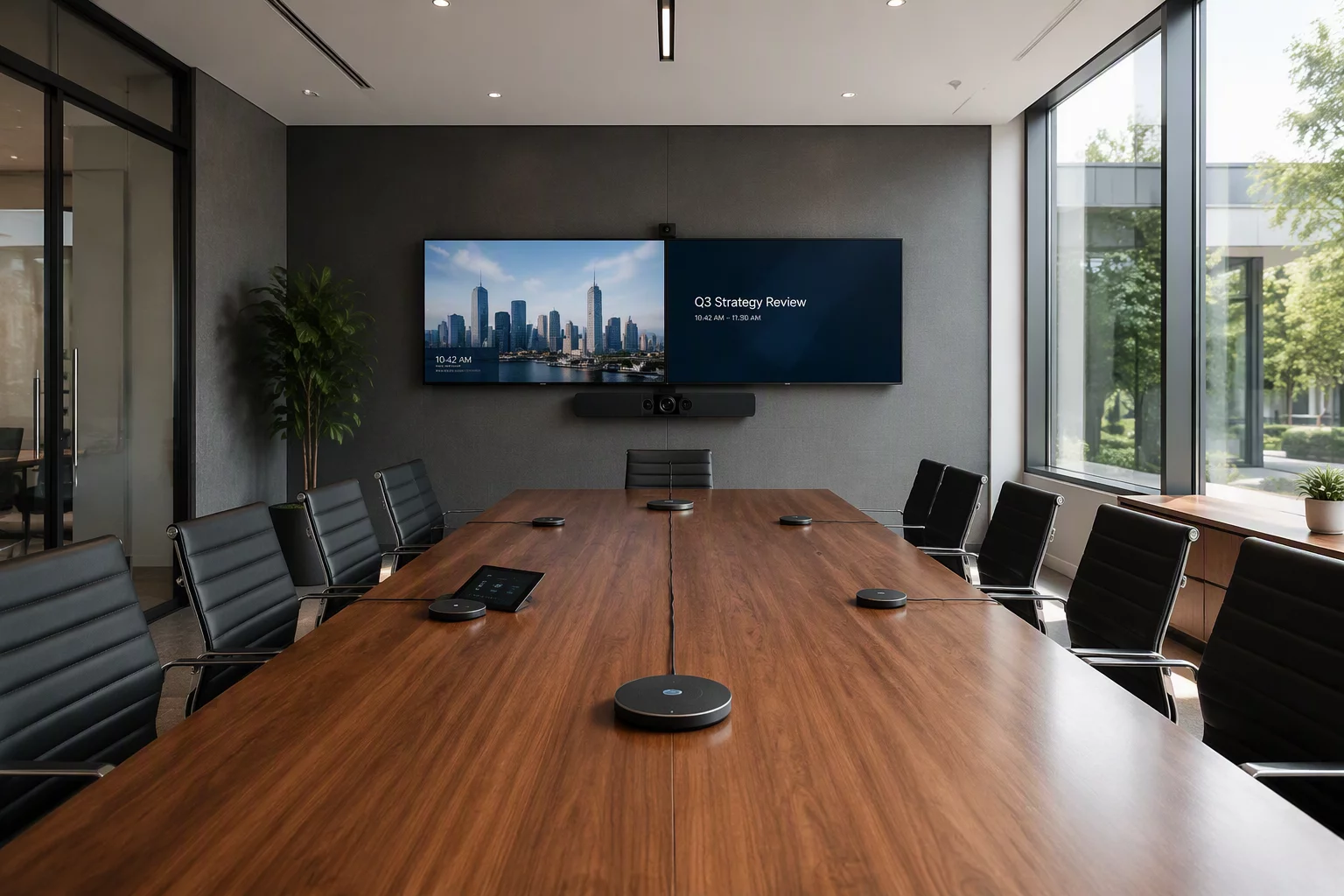
Next-Generation Hardware Architecture & Direct Frame Routing
The latest update to Google Meet Hardware introduces a modernized media ingestion framework that fundamentally changes how video inputs interact with room computing appliances. Traditionally, auxiliary cameras and smartphone bridge feeds suffered from software emulation overhead, resulting in noticeable latency and color degradation. The updated architecture bypasses intermediate frame buffering by implementing direct memory access and kernel-level zero-copy video streaming. This ensures mobile cameras routed via Canno-Studio CS achieve broadcast-grade clarity with minimal hardware utilization.
Hardware & Protocol Specifications
Deployment Pipelines and System Configuration
Integrating specialized phone sensor arrays into enterprise Google Meet hardware kits requires an optimized transmission profile. Modern smartphones leverage advanced computational photography engines that yield superior dynamic range compared to standard conference webcams. Through Canno-Studio CS, administrators can map raw smartphone camera feeds into certified Google Meet room nodes with end-to-end encryption and custom hardware acceleration profiles.
Enterprise Direct Pipeline Activation
Configure the endpoint device to interface directly with Google Meet Hardware room systems without legacy conversion bridges.
- Connect the mobile sensor client via high-speed USB-C or Wi-Fi 6 low-jitter local network socket.
- Select Canno-Studio Direct Hardware Feed inside Google Workspace Admin Console under Room Peripherals.
- Enable AV1 hardware acceleration profile to offload real-time compositing from the host CPU.
Scalability, Security, and Enterprise Integration Insights
IT administrators managing fleets of Google Meet hardware kits gain substantial flexibility through modular virtual camera architecture. Rather than replacing costly optical PTZ cameras when higher resolution or wider angles are needed, organizations can deploy high-spec mobile hardware as secondary presenter feeds. The direct hardware handshake maintains enterprise-grade security protocols, running isolated sandbox processes that keep data streams strictly confined to local networks.
Community Notes & Verification
Verified FeedbackChris
Systems ArchitectGood architectural overview.
Share Verification Observation